
A child might feel disappointed after losing a game, worried about making a mistake or upset following a disagreement with a friend.
When we talk to children about these experiences, it can help to explore three different things: what they were thinking, how they were feeling and what they did next.
These are connected, but they are not the same.
Giving children ways to recognise these differences can be a useful part of classroom conversations about emotions and relationships.
Thoughts, feelings and actions: what’s the difference?
A thought is something going through our mind.
A feeling describes an emotional experience.
An action is something we do in response.
For example, imagine a child who wasn’t included in a playground game.
They might think:
“Nobody wants to play with me.”
They might feel:
Sad, disappointed or angry.
Their response might be to walk away, ask to join or speak to an adult.
The important point is that we cannot assume what a child was thinking or feeling simply by observing their behaviour.
We need to listen.
We also need to take the experience itself seriously. Exploring thoughts should never mean dismissing genuine exclusion, bullying or other harm.
1. Begin with what happened
When a pupil is ready to reflect, begin with a simple question:
“What happened?”
Give them time to describe the situation.
Try to avoid jumping immediately to solutions or asking them to explain why they behaved in a particular way.
Some children may want to talk. Others might prefer to draw or write.
2. Help children identify feelings
The next question is:
“How did I feel?”
Children may use words such as frustrated, embarrassed, worried, excited or disappointed.
Some may need an adult to offer a few possible feeling words.
Avoid telling children how they must have felt.
They may experience more than one feeling, and those feelings may change.
3. Explore what was going through their mind
Thoughts can influence the way children understand a situation.
For example:
“I can’t do this.”
“Everyone else is better than me.”
“My friend didn’t listen.”
A helpful question is:
“What was going through your mind at the time?”
The aim is to understand the child’s perspective rather than deciding immediately whether their thought was right or wrong.
4. Notice the response
Ask:
“What did I do next?”
This gives the child an opportunity to reflect on their actions without reducing the conversation to good or bad behaviour.
Sometimes a response may have helped the situation.
At other times, a child may want to explore another way of responding if something similar happens again.
The conversation should remain supportive and focused on understanding.
5. What do I know for sure?
There can be a difference between what we observed and what we assumed.
For example:
“My friend walked away” is something a child may have observed.
“My friend doesn’t like me” is an interpretation that may or may not be accurate.
Adults can help children distinguish between the two while taking their feelings and experiences seriously.
This question should never be used to challenge a child’s report of bullying, abuse, discrimination or another genuine concern.
6. What could I try next time?
When appropriate, a final question can be:
“What might I think or do differently next time?”
There may not always be anything the child needs to change.
Sometimes the most important next step is asking for help, setting a boundary or identifying what support they need from an adult.
Children should not feel responsible for the actions of others.
Free thoughts, feelings and reactions worksheet
We’ve created a free one-page worksheet for older primary pupils.
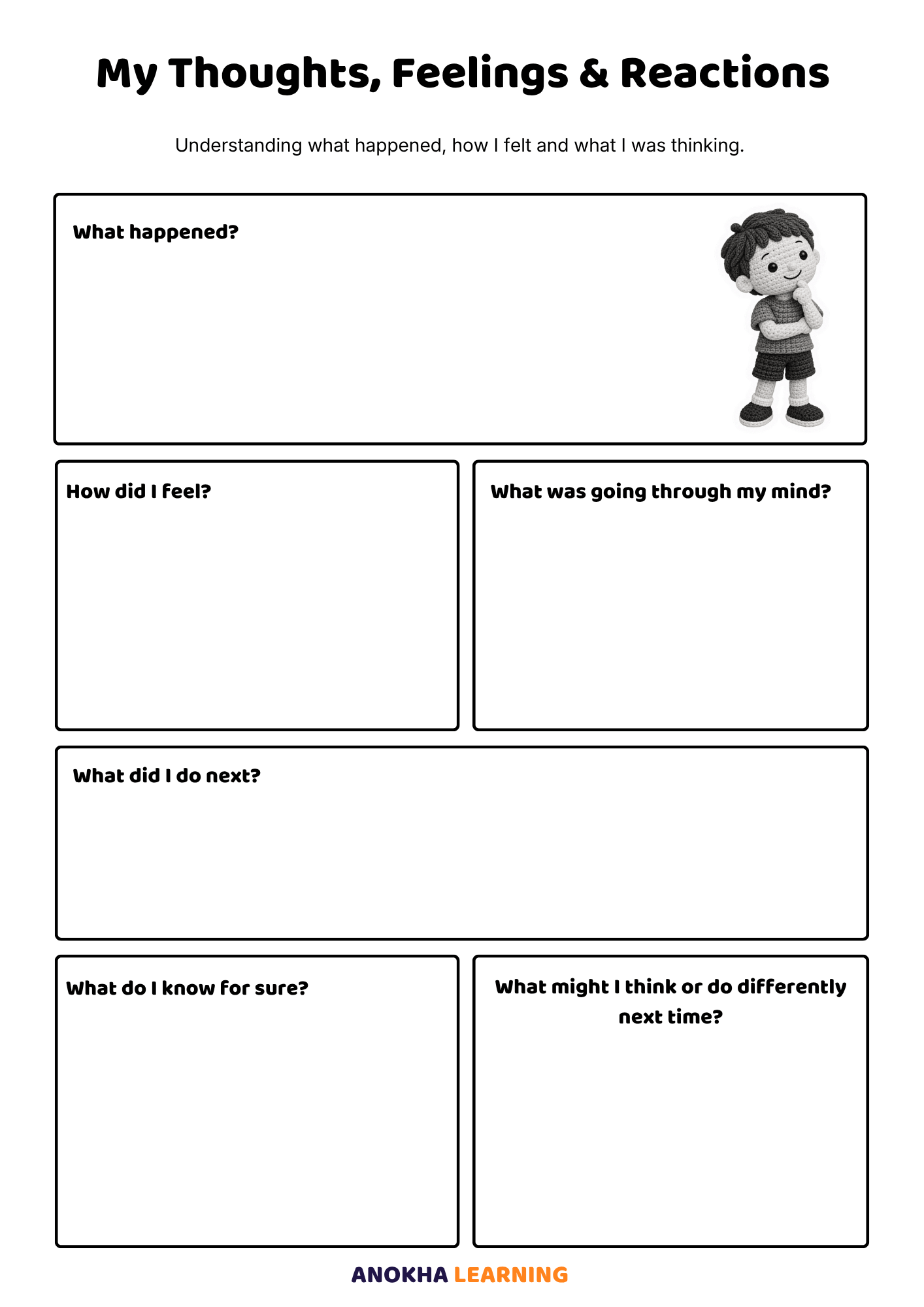
My Thoughts, Feelings & Reactions includes six questions:
- What happened?
- How did I feel?
- What was going through my mind?
- What did I do next?
- What do I know for sure?
- What might I think or do differently next time?
Children can write or draw their responses.
The worksheet is intended for use with a supportive adult, not as a task that a child must complete following an incident.
Download the free My Thoughts, Feelings & Reactions worksheet.
Using reflection activities in an inclusive classroom
Not every child will find it easy to describe their thoughts or feelings.
Teachers can adapt the activity by:
- Reading questions aloud
- Offering a choice of spoken, written or drawn responses
- Scribing a child’s words if requested
- Completing only one or two sections
- Allowing more time or choosing another day
The worksheet is best introduced at a calm moment, with participation optional.
Avoid using it as a behaviour sanction or as a requirement before returning to classroom activities.
It is not a diagnostic tool or a substitute for specialist mental health support.
For broader information about school wellbeing supports, the Department of Education provides guidance and resources for primary school staff.
A starting point for conversation
A reflection worksheet does not need to produce a perfect answer or an immediate solution.
Sometimes helping a child identify one feeling, explain one thought or communicate that they need help is enough.
What matters is that the activity supports understanding rather than becoming another task to finish.
Download My Thoughts, Feelings & Reactions
Explore more free SEN & Inclusion resources.
Over 10,000 Irish primary teachers have taken an Anokha course
Summer 2027 Course Updates
We're planning our Summer 2027 courses. The course lineup, Department of Education approval and booking dates are not yet confirmed. Join our email list for useful teaching ideas, free resources and updates about our summer courses.
Get Anokha UpdatesUnsubscribe at any time.